




At an international level, modern greenhouse units place particular emphasis on improving the quality of the products produced and increasing production. The Action Plan by the Operational Team, through the utilization of relatively recent research data & cutting-edge technologies, aims to lead to greenhouses that are more environmentally friendly, less energy-intensive, with better yields, both quantitatively and qualitatively
This technique seeks to increase production due to an increase in photosynthetically active solar radiation, which will be more evident during the winter months, but also to increase the quality of plants by rejecting harmful ultraviolet radiation.
The study is carried out on a pilot basis in the cultivation of lettuce in a greenhouse of the A.S. Bioproducers of Western Greece, which will have the innovative coating, but also in a conventional greenhouse for comparison purposes, in order to study the effect of the new materials on the growth of the plant and the increase of production per growing season.
Goal of Innogrowth
In particular, they consist of a transparent plate (glass or plastic sheets) in which fluorescent substances are incorporated, such as pigments, quantum dots or rare earth complexes. The emitted light is guided through total internal reflection at the edges of the plate, where it is collected from photovoltaic cells, increasing their efficiency. Initially, solar concentrators were proposed to amplify light in silicon photovoltaic cells and thus increase its efficiency.
At the same time, the possibility of transferring the know-how from the project results after their evaluation in widespread application in installed greenhouses according to the requirements of the conditions in Greece is examined.
The project team is working collectively on the application of the innovative technology of spectral concentrators on a greenhouse surface, while the cultivation, development of the plant and the general quality of the product are monitored throughout the period of its cultivation in order to achieve the maximum result compared to the cultivation of the same plant in a conventional greenhouse.
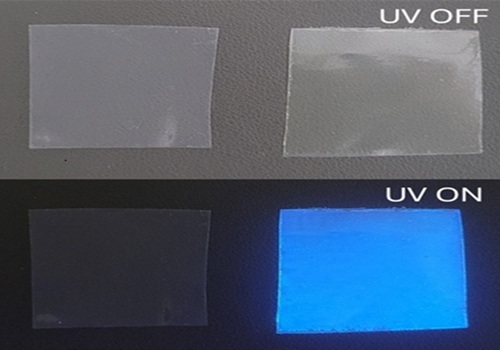
In the context of this research project, the application of a new material codenamed BCNO was presented for the first time, for the synthesis of which extremely cheap and environmentally friendly raw materials were used and which has the ability to absorb UV radiation while at the same time increasing the light after emission at the first photosynthetic peak of chlorophyll.
Indeed, BCNO absorbs UV radiation that is harmful and inactive for plant growth, while emitting bright blue light.
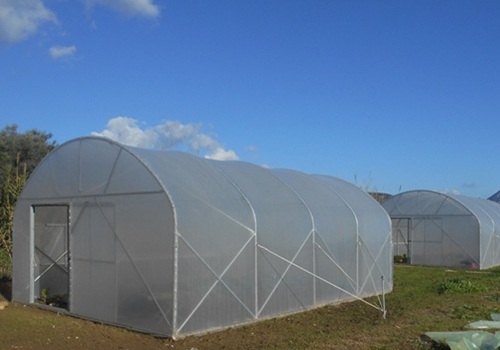
Two greenhouses were built, one of which had the BCNO material as a cover for the plastic shell. The presence of BCNO showed better growth characteristics through the increased fresh weight of shoots and the dry biomass content of lettuce plants compared to those obtained in the typical greenhouse
Of course, this material's ability to enhance photosynthetically active light can be applied to various crops, such as various fruit and vegetables, which are widely grown in greenhouses.